
Precision Cutting: What and How
The term "precision cut" has become increasingly popular lately. Let's try to understand what it means in the mouths of different market participants and how much more precise one cut is than another. I've heard a variety of opinions. Some use this term to describe cuts made by automated machines—to a single design, a single size, and with identical errors. Others use the term to describe more or less perfectly cut stones, with a small window (with a window!) and a mediocre polish, but rare and particularly valuable. Still others say a precision cut must be innovative—incorporating curved facets and even carving elements, and the more complex the design, the more "precise" the cut. Finally, others believe a precision cut is anything that deviates from standard shapes. How can all these opinions be reconciled?
The answer is obvious. According to the meaning of the word, precision cutting must first and foremost be accurate. And only accurate. Not innovative, not artistic, not expensive – simply accurate. This means that the stone should not have cutting defects – meaning noticeable defects. This raises two questions: what constitutes cutting defects and how noticeable can they be? Participating in, judging, and organizing gem cutting competitions has given me some experience in this area. I will try to summarize and elaborate on it.
To answer questions about cutting defects, let's imagine a stone not simply as a single whole, but as a collection of individual design elements, such as facets, edges, meeting points (points where four or more facets meet), and pairs of symmetrical facets (according to the given cutting design). We will consider any deviation from the ideal as a defect – scratches or spots on the surface of the facets, additional facets not provided for in the design, chips, violation of facet symmetry, etc. In terms of size (degree of visibility), defects can be divided into three categories:
A) difficult to discern under a 10x magnifying glass;
B) clearly visible with a magnifying glass, but difficult to discern with the naked eye;
C) clearly visible to the naked eye.
Separately, undesirable optical effects can be identified, such as windowing or light leakage. By counting all these defects, taking into account their size, it is possible to speak with sufficient accuracy and objectivity about a numerical expression of the quality of the cut.
Therefore, in order for the cutting to be precise, it is necessary to minimize cutting defects during the process, monitoring and eliminating them as they appear.
Fortunately, I didn't learn from professional cutters. I learned my basic skills from an amateur, a Russian woman who is a serious biologist and only cuts as a hobby. No one stopped me while I was working on a stone—I was unafraid to strive for perfection, so I didn't know the limits typical of professionals. Early on, professionals laughed condescendingly at me: why spend so much time on precisely shaping facets? Who needs such a mirror-like polish? Is it worth wasting precious fractions of a carat on "closing the window"? In layman's terms, if the difference isn't noticeable, why pay more? But therein lies the mistake. The difference isn't just noticeable. It's obvious and can increase the value of the stone immeasurably more than the cost of precision cutting.
Let me now clarify and substantiate this statement. To do so, let's take a look back 12 years to 2007. It was my second competition, the Single Stone Competition, organized by the American Cutters Guild, in the Master category. I made a stone and, before sending it to the judges, showed it to a wealthy man in Moscow. He asked me to make him a similar one. I made the stone, but couldn't deliver it—the man had moved somewhere. Since I was already making the same thing a second time, the stone turned out slightly more precise than the first—in some places the meeting points were better, in others the polish was more perfect. Of course, only a specialist could notice this, only with a magnifying glass and only under special lighting, but... I later showed both stones together to many people and asked which one they liked better. As a rule, everyone said the second one. No one could clearly explain why—they just liked it, that's all.
It was a true discovery. It turns out that our eyes are such perfect optical instruments that they can see far more than our brains can comprehend. This difference is perceived emotionally: we like it more or less. But the difference is negligible—two stones cut by the same master, practically one after the other. But even this small detail can influence a buyer's decision: to buy or not. After all, decisions are often made emotionally. What if one stone was cut by a master, and the other by a regular cutter? What if one is precision-cut, and the other is commercially cut?
Over the years, right up to this day, I have been working and continue to work on this difference. When the research is complete, I will definitely publish its results. For now, let's focus on one very important gemological characteristic—perhaps the most important for colored stones—color. Let's look at how precision cutting—or more precisely, mirror polishing—affects a stone's color.
Once again, chance helped me see this for the first time. In 2016, I began teaching courses in precision cutting at GIT in Bangkok. During the course, I cut cubic zirconia specimens. But the classes varied; some students gave me more time to work on a specimen, while others demanded much more attention. As a result, during one course, I simply didn't have time to polish a stone—I had to constantly work with the students. I finished the stone at the polishing stage, which is roughly equivalent to the polishing achieved on the vast majority of stones cut by professionals. Well, finished, and finished. I had no intention of selling it; I simply placed it in a box with another stone, also cut during the class. And then I saw...
Before me lay two completely different colored stones. More precisely, the hue was the same, but the saturation and tone were completely different. But they were cut from the same piece of cubic zirconia, which has no color zoning. The stone's design and facet angles were identical. What influenced the color so much?
There could only be one answer: polishing. To understand the reason, I turned to the physics of the process, or more precisely, to optics. And then everything fell into place. Let's remember the diamond grain size used by commercial cutters. 1-2 microns. It provides good speed and an acceptable result—under a gemological lamp or diffused daylight, the surface appears mirror-like. But under spotlight, when the highlights disappear from the facet surface, fine scratches are visible, and the surface appears slightly silky. This is because diamonds of this size leave scratches commensurate with the wavelength of light in the visible range—from 0.4 to 0.8 microns. This means that light, falling on the facet, is not simply reflected or refracted, passing inside the stone, but also slightlydissipates, which means the unevenness of the surface partially reflects surrounding objects. This gives the stone a grayish tint and lightens it slightly, since surrounding objects act as additional sources of reflected light. As a result, we perceive not our own light, butvisiblethe color of the stone, which differs from the real one. рассеивается, а значит – неровности поверхности частично отражают окружающие предметы. Это придает камню сероватый оттенок и слегка его осветляет, поскольку окружающие предметы являются дополнительными источниками отраженного света. В результате мы воспринимаем не собственный, а видимый цвет камня, который отличается от реального.
I didn't set out to quantify the effect of a good polish on a stone's color. Perhaps one of the GIA scientists will delve into this in depth and conduct a proper study. Fortunately, today's laser optics and electron microscopes make it possible to measure the depth and density of polishing scratches, compare them with the wavelengths of the corresponding light sources, calculate absorption spectra and reflectance, and derive numerical values for visible color characteristics. I didn't set out to do so. I can only state that this fact exists and explain why. I'll add that the color difference caused by polishing depends greatly on the nature of the light source. In diffused daylight, it's not as noticeable, but it completely changes the stone under the light of numerous point sources. This, too, must be taken into account.
Now I want to show how polishing can change the value of a stone, not on abstract synthetic raw material, but on a very specific stone with a very real market value. In March of this year, I had the opportunity to repair an unheated 15.98 carat Madagascar sapphire from Sant Enterprises. I needed to fix a chip, and at the same time repolish it (this was my initiative – the customer simply didn't know about the effect of polishing on the color). You can see the difference. Before the repair, the stone was certified by GIA simply as Blue, after the repair it became Cornflower Blue, which is also confirmed by a GIA certificate. The loss during the repair was only 0.54 carats out of 15.98, which is just over 3%, and the losses from repolishing can simply be disregarded – I'm sure they didn't exceed 0.01 carats.
Of course, I don't mean to say that cutting in general, and polishing in particular, improves the stone's inherent color. Let me emphasize again: perfect polishing allows us to see the true color of the stone, the saturation of which is not diminished by light scattering on the surface of the facets. And the absence of undesirable optical effects caused by incorrect facet angles – such as a window or light leakage – allows us to focus our perception exclusively on the stone's own color.
So, we've covered the first two questions in the title of our conversation—how and why? Now let's focus on the third question—when? Of course, if we have a flawless piece of rough with excellent color, medium tone, and high saturation, we're unlikely to ask ourselves whether it requires precision cutting or a more commercial cut. I firmly believe that the quality of the cut should be no less than the quality of the raw material. But cutters in Sri Lanka, Madagascar, Tanzania, or Mozambique aren't always capable of cutting a stone well, even though they often have excellent rough. As the market for high-quality cutting develops, recutting stones in one form or another is becoming increasingly popular.
So what is recutting, what types are there, when is it appropriate to use it, and in what cases does it produce the greatest effect? These questions aren't as simple as they seem.
I first discussed recutting stones in detail in my presentation at the 2015 Gemological Symposium in Paris. While some work had already been done in this area, I only began to approach the issue systematically and scientifically this year. All the numerous individual cases of recutting can be categorized into three main categories:
- complete re-cutting with possible change of shape;
- re-cutting while preserving the shape of the stone, but possibly changing the design;
- "simple" re-polishing of existing edges.
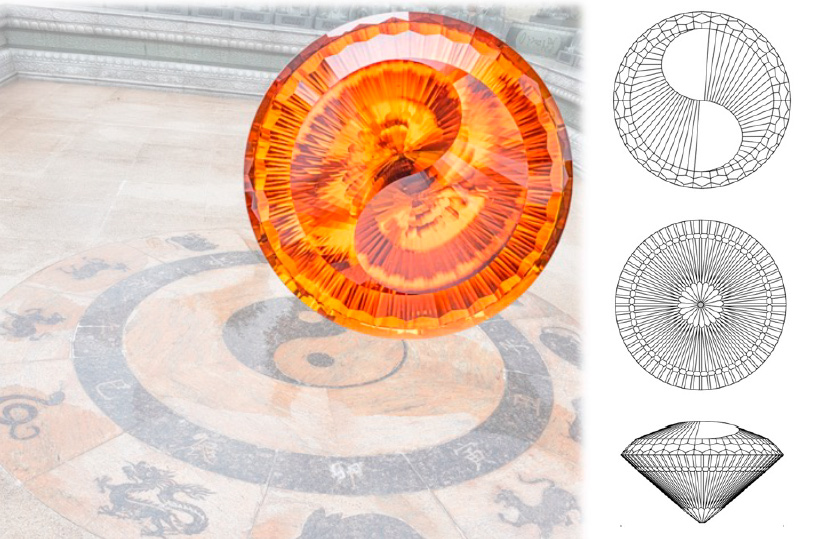
First, let's emphasize that the purpose of recutting is to increase the value of the stone. Clearly, a complete recut requires significant losses and can only be justified when the value of the work significantly exceeds the value of the lost material. For example, in the case of artistic cutting, when the artist creates an art object using inexpensive raw materials such as quartz or topaz. This stunning Lotus was cut from a 257-carat kunzite that had already been cut, resulting in a 37% loss. It has since been featured in numerous exhibitions of my work around the world. You can also see it here. I won't go into detail about stone cutting as an art form; that's a topic for another day. I will simply say that if the price of a painting is determined by more than just the cost of the paint, canvas, and the artist's labor, the same principle applies to cutting art objects. This particular design is called "Touching Perfection." A parable was written about him, which says that a true artist does not care about the means to reflect Perfection - be it canvas, paper, marble or crystal for cutting.
The most common type is recutting while maintaining the stone's shape. There are few classic cuts, the most common being round, oval, cushion, octagon, and pear. However, cutting styles vary. For example, in Brazil, the Portuguese cut predominates, while in Burma and Sri Lanka, a stepped bottom and wedge-shaped top are favored. Commercial cutters typically neglect proper optics, making the pavilion overly convex. This increases the stone's weight, but also creates a "window" that prevents the stone from fully revealing its color. This is often overlooked because, until recently, the market was simply selling raw material, not the stone itself. However, in recent years, more and more importance has been placed on the quality of the cut, and properly cut stones, all other things being equal, enjoy a premium in sales. I dare say this trend will only continue to strengthen.
Therefore, cutters are increasingly correcting already cut stones. The loss depends heavily on the shape of the original stone and can range from 10 to 30 percent. The most advantageous case is when the stone has a high pavilion with a slight convexity, which is typical of some sapphires. In this case, only a small area around the apex needs to be trimmed. A stone with a medium-height pavilion and a "window" due to a large convexity is also acceptable. To close the "window," trimming this convexity is sufficient; this too will cost no more than 10-15 percent of the original weight. However, if the stone with a "window" has a slight convexity and a low pavilion, then it will be necessary to "reduce the face" by trimming the girdle area, and the loss will be the greatest, 25-30 percent.
But when assessing justifiable losses, another factor must be taken into account: so-called "magic sizes." These are threshold values for the stone's weight, at which the price per carat sharply increases. For example, the price per carat of a ruby weighing over five carats significantly exceeds the price of a stone slightly under five. Therefore, if a cornflower sapphire weighs 10.2 carats, you should think very carefully before deciding to recut it.
Well, I've saved the most interesting and rare category of recutting—repolishing—for last. Strictly speaking, it should be divided into two subcategories: regrinding, which corrects the symmetry of facets and meeting points followed by polishing, and pure repolishing, which uses existing facets without changing their configuration.
Actually, when I said "simple repolishing," I used the words in quotation marks. The process is far from simple, if, of course, we want to minimize losses. To repolish a facet, you need to "find" it—in our case, with a cutting machine with a stone mounted on it, you need to find the angular coordinates of the facet—the rotation index around the optical axis and its angle of inclination relative to the girdle plane. If the stone was cut on a modern cutting machine with good symmetry, this significantly simplifies the task. Then you can fairly accurately predict where to look for symmetrical facets. In most cases, however, each of the 150 to 200 facets must be searched for individually. Typically, finding the facets requires more time, attention, and effort than the repolishing itself.
I just talked about losses. Repolishing with a slight change in facet symmetry requires little weight loss—usually no more than 1-3 percent of the stone's original weight. If we're talking about a pure repolishing, the losses are completely negligible; they amount to tenths, and sometimes even hundredths, of a percent. My first repolished stone was a 44-carat unheated sapphire from Lanka. The loss was just over 0.01 carats, or about 0.03%. Now you understand why I'm willing to classify pure repolishing as a separate category. Compared to recutting, the losses are almost a hundred times less! It's like a diamond, the last on the hardness scale, being tens of times harder than its closest neighbor, a sapphire.
I'd like to emphasize once again that this type of repolishing is the pinnacle of cutting. Of course, it shouldn't be entrusted to an ordinary cutter. One day, a friend of mine from Belgium—a second-generation cutter, the son of a cutter, who has been working in the industry for over 15 years—came to visit me. He asked me to demonstrate precision polishing. After four days of trial and error, having polished his first stone using my technique, he exclaimed, "This is a completely different world! I've never seen anyone in Europe polish like this!" He later wrote to me that, after showing this stone to his client, he immediately received nine new orders.
How can I bring these new quality standards to market? One of my clients, after ordering several stones from me, later reproached me: "What have you done to me? Now I can't buy anything at the market—I only have to look at it through a magnifying glass and I lose all desire to buy a stone!" That's why I came to you today. Our conversation is just a modest brick in the wall, a small part of the work I have outlined for myself to achieve this goal. This work encompasses all participants in the stone market. I work with consumers—private buyers and collectors—by exhibiting my work at exhibitions and promoting it. I work with jewelers and jewelry brands, creating cutting designs and faceting specific stones for them. I work with stone dealers, performing both initial cutting and recutting of finished stones. I work with cutters, training them and sharing my experience. I can proudly say that many of them have achieved very high results in cutting competitions—like my student Pavel Filinov, who won the American Cutters Guild competition in the Grand Master class with a perfect score of 100 out of 100. Finally, I work with gemologists and appraisers, speaking at conferences and sharing the latest in precision cutting. At the beginning of our conversation, I discussed the numerical expression of cut quality. Based on the judging criteria for cutting competitions, I have developed a fundamentally new system for assessing cut quality, the key features of which are high accuracy and objectivity. This could be the topic of a separate discussion.
In conclusion, I'll talk about the future—what we plan to do next year. An agreement has already been reached to hold the first two stages of the World Cup in cutting techniques. The competition will be held here in Thailand, a recognized global center for the colored stone market. Negotiations are currently underway with Gemfields, which has agreed to serve as the general sponsor. Three judges—three of the best cutters from America, Europe, and Asia—will evaluate the participants' work using the aforementioned scoring system. In addition to cash prizes, a global ranking of the best cutters will be compiled and maintained based on the results of these competitions. This ranking will be open to all interested parties, including dealers, collectors, gemologists, and others who may require precision cutting. The details of this project are currently being worked out, and I believe an official announcement will be made soon.
If you have any questions, I'll try to answer them. But please bear with me, my English isn't nearly as perfect as my cutting.