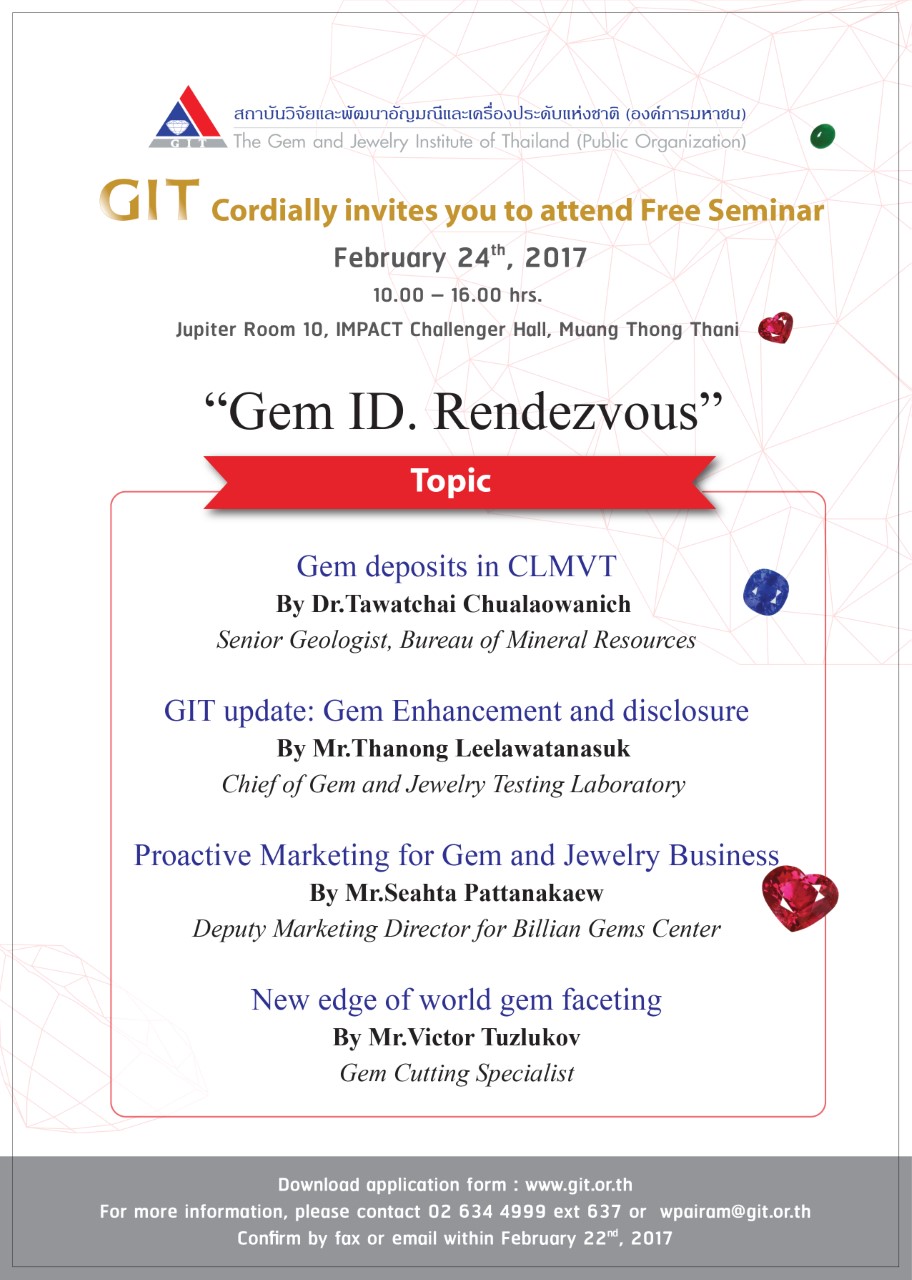

"Precision and artistic cutting"
I'd like to use my designs as an example to explain how cutting stones can evolve from a craft into an art form; how the price of such works can be determined; how the quality of the cut can influence the price; and what criteria are used to evaluate this quality. Then, as an example, I'll give an introduction to our competitions.
- A new approach to stone cutting as a reflection of new market trends.
- When does the craft of cutting become an art?
- Features and benefits of precision cutting.
- How can precisely cut stones and cut art objects be valued?
- The cutting quality assessment system and its role in market development. Quality grades.
- Diamond cutters' competitions as a method for stimulating and developing the precision cutting market. Announcing the 2017 Thai Open.
- Conclusion. Prospects.
1. The gemstone cutting market is changing today... I've started my speeches with these words many times before, and I'll repeat them today. Dealers increasingly cite high-quality cutting as a competitive advantage. Buyers increasingly prefer well-cut stones, all other things being equal, even accepting a higher price. Stones with large "windows," crooked facets, or scratched surfaces are increasingly being recut. Stones are increasingly being wiped, and sometimes even washed, before sale to enhance their brilliance and polish. This is happening everywhere: in America and Australia, in Europe and the Middle East, in Brazil and Canada, in India and Colombia. Thailand, as a recognized global center for the gemstone market, naturally cannot escape these changes. But today, we have a real opportunity not just to join this process, but to organize and lead it.
Lest anyone here think I'm mixing dreams with reality, I'll try to substantiate this bold statement, backing it up with facts and examples. Evolution is irreversible. It has many paths, but one direction—development. A perfect illustration of this is the jewelry market, which is closely related to our industry. Long gone are the days when roughly chopped, then roughly finished, pieces of precious metal were hung on the body or clothing. As time went on, pieces became ever more refined, sophisticated, and beautiful. Of course, even today, some designers try to use naturally shaped nuggets or deliberately simplified, crude designs as jewelry. But they don't set the tone for the market, they don't command prices, and they aren't the ones people try to emulate. Of course, it's difficult to emulate such outstanding artists as Joël Arthur Rosenthal, Kevin Coates, or Wallace Chan. As true creators, they were far ahead of their time. But technology is also improving, and what was impossible yesterday is becoming possible today, and commonplace tomorrow. The market is evolving, and this development is irreversible. Let's remember this.
Gemstones are generally harder than metal; they can't be cast or grown into any shape, as 3D jewelry models are today. Therefore, the quality of stone processing lags behind that of gold or silver. And this difference becomes so obvious that it's hard to ignore. My first student, who mastered the basics of precision cutting, once visited an exhibition of works by the famous jeweler Carl Fabergé. The first thing he said after the exhibition was: "What beautiful pieces, and what terrible—dull and crooked—stones!" It's hardly an excuse to say that "stones have always been cut this way." Yes, just yesterday they were crooked and dull. But today they are becoming more perfect, which means they will shine with perfection tomorrow.
2. Today, three main directions can be identified in the development of gemstone cutting. These are: the emergence of new shapes and fantasy designs; the addition (or replacement) of flat facets with curved surfaces; and the improvement of processing quality – polishing, symmetry, and facet alignment. In the first direction, one can highlight working with the optics of the stone – the conscious creation of various unusual optical effects using the laws of reflection and refraction of light. I will say right away that, while acknowledging and understanding all these directions, I do not use curved surfaces in my work. They create an unusual optical effect of fracturing internal reflections, but at the same time, the play of the stone, which is characterized by its dispersion – the decomposition of light into its spectral components, when flashes of colors that are not inherent in the stone appear – disappears. Curved surfaces do not create virtual prisms that decompose light rays, and the stone loses one of its main advantages.
But there can also be merits of a different kind. Many people today write books or paint pictures, some create compositions from wood or stone, others compose music. We like some of their creations more than others. But sometimes, upon seeing, hearing, or experiencing a certain Work – a Work with a capital letter, filled with the soul of the artist, sculptor, or writer – we become different. We want to laugh or cry; we are overwhelmed with emotions that we want to share – a thirst for creativity awakens within us. It is this ability to evoke a creative resonance in people that distinguishes those objects that we call works of art.
But if a book, a painting, a sculpture, or even a piece of jewelry can be an art object, then why can't a cut stone be an art object? The beauty of the stone and the precision of the cut are simply not enough. What's needed is a composition, an idea—and the more powerful this idea is in its emotional impact and the more precisely the artist expresses it, the greater the art will be. Moreover, an art object doesn't necessarily need to be highly complex—a painting is large, a book is thick, or a stone is incredibly multifaceted. Sometimes, the simplest means can convey profound ideas. For example, the great Hemingway once bet he could write a story of just four words that would make readers weep. "For sale: baby shoes. Never worn..." And so, in those four words, we experience the full depth of grief of a family who has lost a child, and with it, all hope.
Let me give another example – this time a comparison. In Germany, in the town of Idar-Oberstein, the craft of stone processing has long been developed – not only cutting, but also carving. The figurines of animals and insects are often magnificent in their quality of execution. Mice, frogs, butterflies, snails – they look lifelike, so carefully and meticulously are they carved. But can this be called art? Yes, the mouse looks alive – so what? It's no coincidence that the local craftsmen value their products very simply – the price of the material plus the cost of labor, based on the time spent. Therefore, such objects don't even have names – why give a name when it's already clear what you're looking at – a frog, a snail, or a parrot? But here's another work – by a Russian stone carver who has been working in New York for a long time, Slava Tulupov, entitled "Balance." It's also a snail made of blue chalcedony and smoky quartz, decorated with gold and diamonds and mounted on a round, mirror-polished platform of black obsidian with a similar gold border. Or rather, above the platform – as if balancing a few tenths of a millimeter above the surface. According to the artist's intention, it should rotate, and its spiraling shell seems to screw into space, associatively resembling the spiral of the evolution of life. At the same time, its flat reflection in the transparent obsidian, above which it seems to float in serenity, evokes thoughts that our world and our life are merely a three-dimensional imprint of some more complex and multidimensional images and processes. This is no longer craftsmanship. This is art.
The same applies to stone cutting. Various means can be used to create a composition—color phenomena, optical effects, unusual inclusions, or even a cutting pattern. I've often presented a collection of cut stones under the general title "Philosopher's Stone." Some of you are already familiar with it. The facets of each stone depict one or more symbols. Parables are written about the stones, outlining various philosophical concepts, and these symbols play a key role. What is man's place in the Universe? How should man interact with the world to avoid destroying his home? What can each of us consider our greatest treasure? What is the path to Wisdom? And, most interestingly, each stone, and each concept, respectively, reflects one of the stages that make up the evolutionary development of Man and the Universe.
3. However, the emergence of cut stones as art objects is not yet a market trend, just as the first drops of rain are not yet a storm, although they sometimes foreshadow one. What can be called a trend is the fact that the quality of cutting is improving along with technological advances. What is a high-quality cut? And what is not just high-quality, but perfect, precision cutting?
Let's recall the main purpose of a faceted stone as an optical instrument – to reflect and refract light rays falling on the stone, thereby maximizing the combination of its natural color and the perfection of the form given to it by man. First, let's deal with the color. Above all, the color of the stone should be influenced as little as possible by surrounding objects, that is, the stone's own color should be as pure as possible. If the stone has a "window," then in the area of the "window," the color of the stone itself will mix with the color of the background, and the lighter and less saturated the color of the stone, the greater the negative impact of the "window." In addition, a poorly chosen design or incorrectly set facet angles can lead to light leakage from the stone through the side facets. This also degrades its color.
The second factor influencing our perception of a stone's color is the quality of the polishing. In commercial cutting, a fairly coarse abrasive is usually used for polishing to speed up the process. However, this abrasive leaves noticeable marks – scratches on the surface of the stone. And, since the depth of these scratches significantly exceeds the wavelength of visible light, the light waves are partially scattered on the surface, introducing a gray component from reflections of surrounding objects into the stone's color and reducing the stone's contrast. Have you noticed that when buying stones, dealers always try to handle the stone with their hands? One of the reasons is that fingerprints make the facets slightly matte, the stone becomes duller, and this is an additional opportunity to lower the price. In this case, the tiny droplets of oil on the surface play the same role as the scratches from commercial polishing. To see this even more clearly, cover the stone with a soapy solution, and then rinse it with a stream of water. The difference will be obvious.
As for the shape, it's important to consider how well the stone itself conforms to the design set by the cutter. It doesn't matter whether this design was drawn as a diagram, printed as a chart, or exists only as an image in the master's mind. In any case, it is characterized by symmetry and precision in the pattern of the facets (I'm not talking about cases where the design is deliberately asymmetrical). Don't think that because gemstones are usually small, inaccuracies in the pattern are invisible to the eye. Our eye is a perfect optical instrument; in complete darkness, it reacts even to individual quanta of light. It's just that our brain, to prevent information overload, automatically "filters out" what seems insignificant. And this "filtered out" information settles somewhere in the depths of the subconscious and is perceived by us at the level of sensations. Have you noticed that you want to hold some stones in your hands longer, while you want to give others away as quickly as possible? That's how our subconscious perceives the harmony of the stone. Or the disharmony.
4. But if there's a difference in quality, there must also be a difference in price. In any market, there are several quality categories for goods. Roughly speaking, we can distinguish between handicrafts, high-quality mass-produced factory goods, products from famous brands, and exclusive, one-of-a-kind pieces of the highest quality, which is not yet possible to produce on automated production lines. The price difference between these categories isn't a matter of percentages, but several times. As the cost of materials increases, this difference, of course, decreases, but even in the jewelry market, where materials are expensive, this difference is quite noticeable.
Why doesn't this principle always work for gemstones? Why, when a person picks up a beautifully cut stone that they like, do they find out the price per carat and compare it to average market prices? Why doesn't it occur to them to compare the quality of the cut to the average market quality as well? The answer is simple: today, no one can definitively say what constitutes a good cut and how good it is in each specific case. This means that the assessment of quality is always subjective. If, in the "seller-buyer" pair, one is more experienced, they can always convince the other that this particular cut is good or bad – depending on their own advantage. If both understand little about it, then there's nothing to discuss at all.
But high-quality cutting requires much more time, highly skilled craftsmen, and more expensive equipment. It takes great courage to produce a high-quality cut—it will cost more, and there will be no proof of quality. Even if the end consumer is willing to pay more for better quality, between them and the manufacturer stand two layers: jewelers and dealers, who strive to make as much profit as possible, since it's their business. They want to buy as cheaply as possible and sell as expensively as possible, using various tricks—lighting conditions, time of day, the buyer's mood, the environment, even the way they hold the stone (remember: hands like tweezers?). And for a perfect, precision cut, which costs much more than a standard one, it's downright difficult—few people can even distinguish it from a merely good cut.
We have now arrived at a very important point. The lack of a unified, logical, and effective approach to evaluating the quality of gemstone cutting is hindering the development of the jewelry stone market. In other words, the need for such an approach has objectively become urgent. And if something becomes necessary, it will appear. Perhaps initially in some first, still imperfect version, only to then, transforming and improving in accordance with market conditions, become a generally accepted standard.
The current system for evaluating the cut of colored gemstones is based on a similar system for diamonds: symmetry, proportions, and finish – on a five-point scale. However, there are two serious drawbacks. Firstly, this approach is based on the use of a set of standard shapes (not designs – but cutting shapes: round, pear, oval, etc.) and evaluating deviations from these standards. But there are no standards in colored gemstone cutting; the cutting style in Brazil, for example, differs from that in Thailand or Sri Lanka. The proportions of the stone depend heavily on the design of the jewelry – in some cases, the oval should be narrower, and the pear shape wider. Not to mention the thousands of fancy designs that don't fit into any standard proportions at all.
Secondly, the five-point scale is highly subjective and allows for subjective evaluation. In reality, the score gradations are not points, but ranges of values with a certain tolerance interval. For example, how do you assess whether the polishing quality is still VERY GOOD, or already EXCELLENT? And what if there is only one very fine scratch on the surface – is that EXCELLENT or not? And what if there is only one, but deep scratch? All of this is subjectively determined by the expert; another expert may disagree, and it is impossible to confirm or refute these viewpoints.
5. Based on these considerations, a different system for evaluating cutting quality was proposed, based on the judging criteria used in gem cutting competitions – criteria slightly modified and adapted to market conditions. Of course, it requires some effort and is unlikely to be practical for commercial cutting. However, if it is necessary to determine and confirm the quality of precision cutting, it is indispensable due to its universality, conceptual simplicity, and at the same time high accuracy (100-point scale with 4 decimal places) and objectivity. Of course, it requires some experience from the expert, but it does not require any additional gemological knowledge.
Unlike existing methods, this system takes into account the complexity of the facet design. Its key concept is the design element – a homogeneous fragment of the stone's surface that may (or may not) have any facet defects. Such elements include: a facet, an edge, a point where four or more facets meet, and pairs of symmetrical facets according to the given facet design. During the inspection, the design elements with defects are counted – scratches, chips, misalignment, uneven shape (in the case of a pair of symmetrical facets), and so on. Depending on the number and severity of these defects – in relation to the total number of design elements – a spreadsheet uses special formulas to calculate quality points, and based on these points, derives an overall rating for the stone.
But that's not all. In addition to the overall rating, this system proposes grouping the quality of the cut into classes and subclasses. Each of the three classes – Commercial, Quality, and Elite – is, in turn, divided into three subclasses. While the subclasses of the first two have simple numerical designations, in the Elite class they have their own names: Elite Premium, Elite Extra, and Elite Ideal. The last, highest subclass, includes stones with a rating of at least 99 points out of a hundred, and also with a number of restrictions. This is absolute exclusivity in the cutting market. If (according to very approximate estimates) most stones on the market today are in the Commercial class, then even the Quality-I subclass is represented by fractions of a percent, and there are practically no stones in the Elite Ideal category at all. This does not mean that they cannot exist even theoretically. Sometimes, 100-point stones even appear at cutting competitions. But these are the domain of competitive cutters, who are still very far from the market.
I dare say that this system for evaluating the quality of the cut will be the missing link that will help the market develop. Of course, there's no point in evaluating the quality of the cut if it's clearly below the "Quality" class. But a document confirming an "Elite" class cut will provide both sellers and buyers with strong arguments.
From my own experience, I know there's a category of buyers willing to pay significant sums for the very best. Let's consider diamonds for a moment. Why do stones with IF clarity cost significantly more than similar stones with VVS1 clarity? Could any end buyer actually see that tiny point that makes the difference? No, that's not the point. Stones without that tiny point are much rarer and – most importantly – the clarity category is confirmed by a certificate based on an accepted classification system. Why shouldn't the same apply to the quality of the cut?
6. I mentioned gem cutting competitions. I'll say a few words about them. There are two main types: creative competitions and technical competitions. In the former, the judges aren't so much on the quality of the cut as on the beauty and rarity of the stone itself, the originality of the design, and the complexity of the execution. In the latter, the judges are solely on the precision of the cut and the quality of the polish. Don't think it's that simple. Over the more than thirty-year history of the International Cutting Competition in Australia, which has the status of an unofficial world championship, the "100 Points" Club was established, uniting those who have cut stones with the highest scores. Today, it includes 12 names—both living and deceased cutters. 12 people from all over the world over the course of 30 years of history!
Typically, creative competitions (such as Spectrum Cutting Edge in America, the IU Award in Hong Kong, the Antonio Neguruella contest in Spain, etc.) are attended by professional gem cutters. However, competitions focused on cutting technique mainly involve amateurs who can afford to work on a single stone for several days, or even weeks, perfecting it. The first modest attempt to combine these two approaches was made in Russia in 2012 as part of the international competition Russian Open'2012. And now, five years later, Thailand has taken up this baton – at a qualitatively different level, with state support.
Ladies and gentlemen! I have the honor of announcing the first Thai colored gemstone cutting competition, which will be open to professional and amateur gem cutters from around the world. The competition is organized by the Gem and Jewelry Institute of Thailand with the support of the government and will consist of two parts – the Main Challenge and the Freestyle Challenge – with participants cutting two stones each. One stone will be cut according to a given design and specified dimensions by all participants – this will be the technical part of the competition. For the second stone, the material, design, and dimensions will be chosen by the participant, and the evaluation will consider not only the accuracy of the cut, but also creative elements – the raw material, the complexity and originality of the design, and the beauty of the stone. A competent jury will evaluate the stones in accordance with the rules of this competition, developed by GIT, using the colored gemstone cutting quality assessment system that has been mentioned previously.
The competition program includes prizes and cash awards for the winners: USD 2000 (1st place), 1500 (2nd place) and 1000 (3rd place). In addition, if any participant scores more than 90 points for each of the two stones, they will receive an Advanced Competition Cutter certificate, and those who score more than 95 points will receive a Master Competition Cutter certificate.
7. So, what are the prospects? For market changes to become tangible, all market participants must be ready for them. For precision cutting to firmly establish its market niche, it is necessary to prepare both end consumers and manufacturers – the cutters – and the intermediate link – dealers and jewelers. And today we have the opportunity to work in all these areas. We publish materials and photographs in the media, showcase samples at exhibitions, talk about our conferences and cutting competitions, and involve the public in the judging panel – and people are learning that cut stones can be perfect. On the other hand, last year, GIT, with the support of government agencies, began conducting courses on precision cutting using American-made machines – and the first market professionals had the opportunity to produce such stones. Thirdly, a new approach to evaluating cutting quality will allow us to determine what precision cutting is, how precise it is, and will provide dealers with the necessary arguments to justify price increases. And finally, we – gemologists – can bring all this together and lead this process.
Thank you for your attention!