
It's common to begin articles about the Russian School of Cutting with the following line: "It's well known that the term 'Russian Cut' has long been synonymous with the highest quality..." Well, in the diamond market, this is indeed a fact. But today, we're not talking about diamonds. Russian gemstone cutting isn't as well-known internationally, as Russia isn't a major supplier of colored stones to the market and is unlikely to significantly influence global cutting trends. This was previously believed, and many still believe so. But recent years have brought about some adjustments that have ensured the triumph of Russian gemstone cutting today and demonstrated that our country's prestige in the world of precious stones rests not only on the strict technical quality control of the Soviet era.
The story of this triumph began six years ago, when several Russian gemstone cutting enthusiasts joined the American Gem Cutters Guild and took part in cutting competitions in the United States. Thus, with its first, still tentative steps, Russia began to integrate into the global gem cutting community. While treading this modest and unnoticed path, our enthusiasts had no idea what elephants would run along it in the near future... The result—third place in the Pre-Master category, second out of four (Novice, Pre-Master, Master, Grand Master)—can be considered a good start, given the novelty of this experience for Russia. For the first time, we learned that cutting can be not only a craft, a routine daily task, but also a sport—a passion in which one can improve through persistent training, competition, and winning awards.
Reference
The Russian Gem Cutters' Guild was founded in 2011 and registered with the Ministry of Justice in February 2012 as a non-profit partnership uniting gemstone cutting enthusiasts. The guild's goal is to promote the expansion of people's consciousness by satisfying the need for creative self-expression through gemstone cutting.
The next three years were devoted to training and competitions—again in the United States, England, and Australia. In 2008, the author of this article competed for the first time in Australia at the International Faceting Challenge, a world championship competition. The recognized leaders were the Australians and Americans, whose friendly match in 1984 marked the beginning of the competition. Wing Evans deserves special mention, becoming a five-time world champion in 2008 and setting a record of 298.84 points out of a possible 300 in 1998.
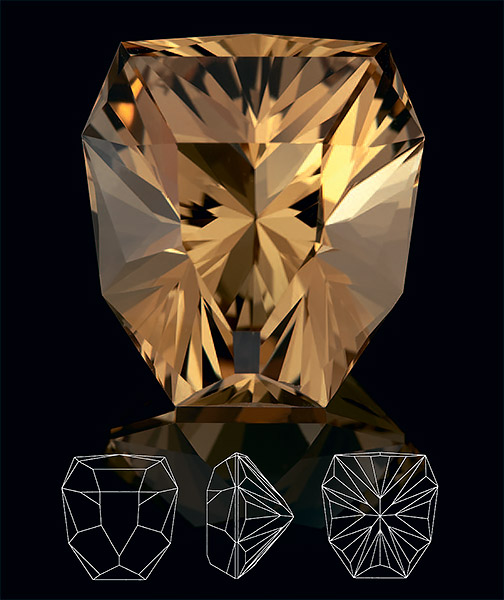
Here, it's appropriate to briefly explain what gem cutting competitions are and how sport cutting differs from commercial cutting. Competitions are typically held remotely. Participants cut stones according to specified diagrams—without time limits—and submit them to the Organizing Committee, where experienced judges evaluate the stones based on specific criteria. These include polish, flatness and precision of facets, sharpness of the stone's edges, absence of chips or additional facets, symmetry, compliance with specified dimensions, and so on. Penalty points are awarded for defects and deviations, which reduce the score—a maximum of 100 points for each stone. Thus, sport cutting is a pursuit of perfection within established rules, unlike commercial cutting, where the weight of the resulting cut stone is paramount, often compromising its beauty and harmony.
Let's return to history. 2010. Amid the more than modest success of the Russian team at the Olympics, a stunning success, for many, occurred in distant Australia: a Russian cutter (the author of this article) won the individual World Championships with a new world record, surpassing the 299-point mark for the first time in history and the previous achievement of the aforementioned five-time champion Evans. "It's incredible!" commented the President of the American Cutters Guild in his congratulatory address. "Consistency was the hallmark of this victory," sighed the championship hosts. Indeed, the score on all three qualifying stones neatly exceeded 99.5 points. "I did what I could," our champion said in an interview with Australian television.
So, 2010 brought Russia a resounding victory. But it was a solitary victory. It was difficult to speak of the merits of the Russian School of Gem Cutting. Of course, we have many skilled craftsmen. But... You can play tennis better than Kafelnikov and Safin combined, but if you don't compete, you're out of the game, and your skill is irrelevant to the country's prestige. Our gem cutters needed to consolidate their success by participating in the team championship. To this end, in 2011, the Russian Gem Cutters' Guild was established and the first Russian Gem Cutting Competition was held as a qualifier for the 2012 World Championship. Following these competitions, two teams were formed – one Russian and one Armenian. It was the help of their Armenian friends that enabled the Russian team to finally qualify and take silver in the team championship, despite the fact that two Russian gem cutters were unable to participate and the team's performance was in jeopardy.
But this wasn't the only achievement of the year. In June, an international gemstone cutting design competition was held in Hong Kong. And again – a convincing victory for Russian cutters. Gold, silver, and an encouragement prize for fourth place – in the piggy bank of our team. Twenty-eight participants from eight countries demonstrated their art in gemstone cutting design. Five members of the jury, including one of the world's most famous jewelers, Wallace Chan, the vice-president of Harry Winston, Dr. David Schwartz, and the author of this article, meticulously evaluated the masters' works. Everyone was captivated by the simple colorless topaz of Russian Natalia Samorukova, in which a wonderful chrysanthemum was formed not by the pattern of facets, but by reflections inside the stone. The "Snowflake" by Eduard Akhmetshin from Moscow was also highly praised, and he only slightly lagged behind the champion.

In the autumn, with the support of the Russian representative office of the International Colored Gemstone Association, the first open Russian gem cutting competition, RUSSIAN OPEN 2012, was held, in which nine gem cutters from five countries participated – Great Britain, Germany, Switzerland, New Zealand, and Russia. The highlight of these competitions was the "Younger Brother of the Diamond" contest, organized by the company "Grannik," which produces and supplies synthetic moissanite – a jewelry-grade silicon carbide – to the market. This unique stone for jewelers is only slightly inferior to a diamond in hardness, and significantly surpasses its "older brother" in optical characteristics. The announcement of the results and the awarding of the winners took place at the "Symphony of Gemstones" exhibition on November 10 in Moscow. Based on the sum of the two programs – mandatory and optional – the winner was Helen Temple from New Zealand. Second place went to Andrey Dubinin from Vladimir, Russia, and the bronze medal was awarded to Felix Kircchofer from Switzerland. Prize-winning places in individual events were also awarded to Dmitry Samorukov and Dmitry Petrochenkov from Russia, and the Englishman Jim Finlayson won the "Younger Brother of the Diamond" contest.
The official website of the Russian Gem Cutters' Guild is still under development, so for now, this magazine is your only source of information about the Guild's news and achievements. Stay tuned for our publications!
Viktor Tuzlukov
Chairman of the Russian Guild of Cutters
Grandmaster of the United States Gem Cutters Guild. World Champion and Record Holder in Colored Stone Cutting.
Stone Alphabet | Jewelry Moscow
Jounalism
- Two Museums
- Precision Cutting in Thailand
- The Symbolism of Gemstone Cutting
- The Global Success of the Russian School of Cutting
- The Diamond's Younger Brother
- About the Energy of Cut Stones
- Interview with Myself
- Invitation to the Tale
- It's Time to Collect Stones
- Mexico. Echo of Bygone Times.
- Other Articles